
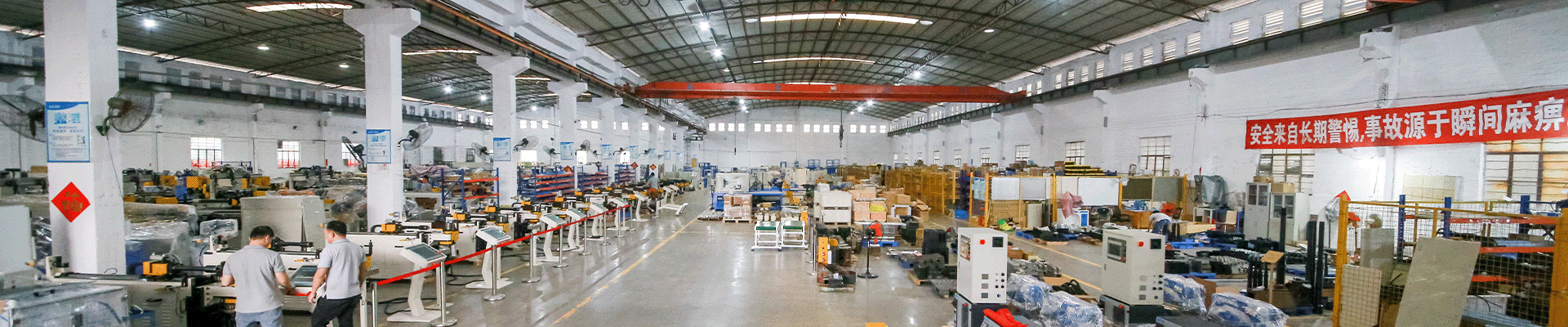
As HVAC, automotive, refrigeration, and heat exchanger industries continue moving toward lightweight tubing and automated assembly, manufacturers are under increasing pressure to improve forming precision, production speed, and connection consistency. Traditional manual processing methods can no longer meet the requirements of modern tube production, especially for copper, stainless steel, and aluminum tubing used in high-volume manufacturing.
This is where the modern tube end forming machine becomes critical. A CNC-controlled end forming machine can complete expanding, reducing, flaring, beading, and necking operations with high repeatability while reducing labor dependency and secondary processing steps.
For manufacturers building intelligent production lines, integrating a high-performance tube forming machine or pipe forming machine is no longer just about automation — it directly affects leakage rates, assembly tolerance control, and overall production efficiency.
What Is a Tube End Forming Machine?
Definition of Tube End Forming
Tube end forming is a precision cold-forming process that reshapes the end of a metal tube without removing material. Unlike machining or welding, the process changes tube geometry through controlled axial pressure and forming dies.
The most common metal tube end forming operations include:
|
Forming Type |
Function |
Typical Application |
|
Expanding |
Enlarges tube diameter |
HVAC copper joints |
|
Reducing |
Decreases tube diameter |
Automotive fuel pipes |
|
Beading |
Creates retaining grooves |
Hose assemblies |
|
Flaring |
Produces sealing angles |
Refrigeration systems |
|
Necking |
Forms stepped diameters |
Heat exchangers |
In HVAC production, an HVAC tube end forming machine for copper pipes is widely used to create leak-proof refrigerant connections without additional welding fittings. This significantly reduces assembly cost and improves production speed.
Compared with traditional fabrication methods, the modern tube end forming process improves dimensional consistency while minimizing material waste and operator variability.
How Does a Tube End Forming Machine Work?
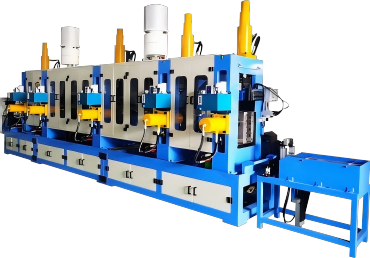
Tube End Forming Machine zfm-d30-5p
A CNC pipe end forming machine typically combines servo-driven motion systems, hydraulic clamping structures, and programmable tooling control.
The standard forming cycle includes:
- Tube loading
- Precision clamping
- Servo-controlled forming stroke
- Multi-step forming sequence
- Dimensional inspection
- Automatic unloading
Unlike older hydraulic-only systems, today’s automatic tube end forming machine platforms use servo motors for forming position control. This allows more accurate wall thickness management and prevents cracking on thin-wall copper or stainless-steel tubes.
For example, in copper HVAC applications, wall thinning during expansion is a major issue. Servo-controlled forming enables more stable deformation speed, improving sealing quality and reducing scrap rates.
A modern multistation automatic CNC pipe end forming machine can complete multiple operations in a single cycle, such as expanding + beading + flaring, eliminating secondary handling processes.
This type of integrated processing is especially valuable for:
- Automotive brake lines
- Heat exchanger manifolds
- Air-conditioning copper tubing
- Medical stainless tubing
- Industrial fluid transfer systems
Servo vs Hydraulic: Which End Forming System Performs Better?
One common purchasing question is whether a servo or hydraulic system is better for industrial tube processing.
The answer depends on tube material, production volume, and precision requirements.
| Parameter | Hydraulic System | Servo System |
| Force Output | Higher | Medium to high |
| Position Accuracy | Moderate | Very high |
| Energy Consumption | Higher | Lower |
| Noise Level | Higher | Lower |
| Thin-Wall Tube Control | Average | Excellent |
| Automation Integration | Moderate | Excellent |
A professional servo tube forming machine manufacturer typically recommends servo systems for:
- Thin-wall copper tubing
- Stainless steel precision tubes
- Multi-step forming sequences
- High-speed automatic production lines
Hydraulic systems still remain suitable for large-diameter or thick-wall pipe processing where extremely high forming force is required.
For many factories, the best solution is a hybrid CNC end forming machine combining hydraulic clamping with servo forming control.
Why Multi-Station CNC End Forming Is Replacing Traditional Processing?
Many manufacturers still use separate machines for expanding, flaring, and beading. However, this creates several production problems:
- Increased labor handling
- Higher positioning error
- Longer production cycles
- Inconsistent dimensions between operations
A multistation automatic CNC pipe end forming machine solves this problem by integrating multiple forming operations into one continuous cycle.
For example, a copper HVAC tube may require:
- Expanding
- Sizing
- Beading
- Chamfering
Traditionally, this would require 3–4 independent stations. A CNC multi-station system completes all operations automatically in one setup.
Advantages include:
- Reduced operator dependency
- Better concentricity accuracy
- Lower reject rates
- Higher daily output
- Improved assembly consistency
This is why many global manufacturers are upgrading toward a high stability tube end forming production line integrated with robotic loading and online inspection systems.
Industrial Applications of Tube End Forming Machines
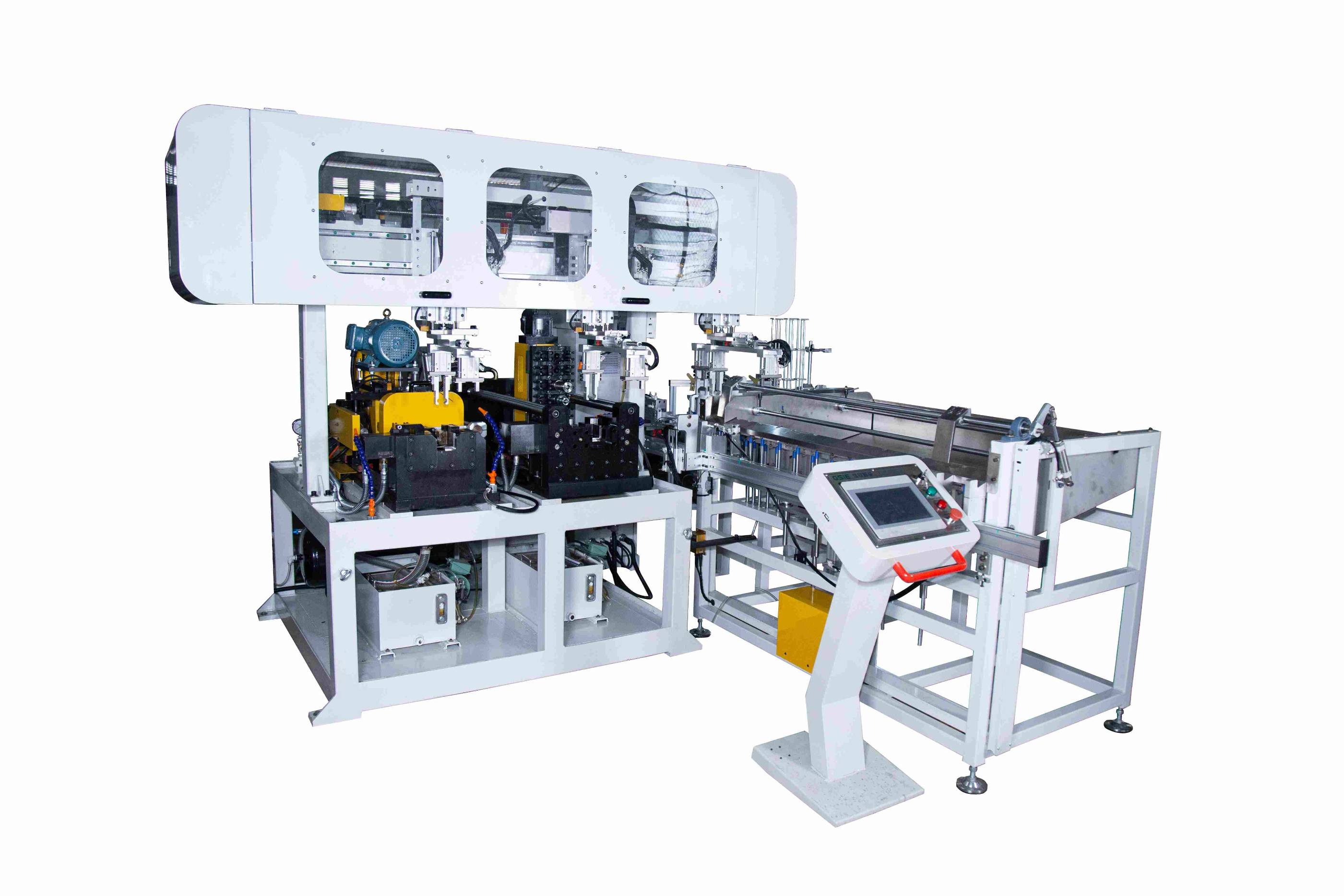
Tube End Forming Machine ZFMS-D20
HVAC and Refrigeration
The HVAC tube end forming machine for copper pipes sector is one of the fastest-growing application areas.
Modern air-conditioning systems require highly consistent refrigerant tube joints with minimal leakage risk. CNC tube end forming allows manufacturers to produce accurate expanded and flared copper joints suitable for automated assembly.
Automotive Industry
Automotive manufacturers use pipe forming machine systems for:
- Brake lines
- Fuel tubes
- Exhaust systems
- Cooling circuits
In EV manufacturing, lightweight aluminum fluid tubes increasingly require servo-controlled forming to prevent cracking and deformation.
Heat Exchanger Manufacturing
Heat exchanger production relies heavily on precise tube expansion and stepped end forming. Poor dimensional consistency directly affects brazing quality and heat transfer performance.
Aerospace and Medical Tubing
Precision stainless-steel tubing used in aerospace and medical applications requires strict tolerance control and burr-free forming surfaces. CNC servo systems provide significantly better repeatability for these industries.
How to Choose the Right Tube End Forming Machine?
Selecting the right tube end forming machine requires evaluating more than just tube diameter.
Professional buyers usually assess:
Material Compatibility
Copper, aluminum, stainless steel, and carbon steel all behave differently during forming deformation.
Wall Thickness Range
Thin-wall HVAC copper tubing requires highly stable forming speed control.
CNC Programming Flexibility
Modern CNC systems should support quick tooling changeovers and recipe storage for multiple tube models.
Production Capacity
A fully automated pipe forming machine can dramatically improve output in mass production environments.
Supplier Engineering Capability
A reliable tube end forming machine manufacturer in china should provide:
- Forming process analysis
- Tooling customization
- Sample testing
- Production line integration
- Remote technical support
Today, many overseas buyers cooperate with experienced china pipe end forming machine supplier companies because they offer competitive automation solutions with customized engineering support.
Instead of simply searching for china tube end forming machine wholesale or china pipe end forming machine wholesale, professional buyers increasingly focus on long-term technical capability, software integration, and process stability.
Future Trends in Tube End Forming Technology
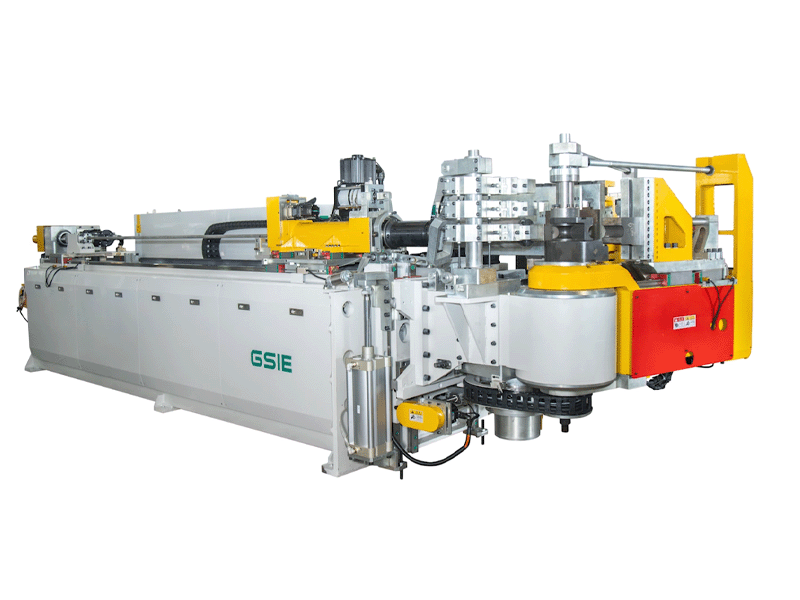
Tube end forming machine SKW-19
Future development in tube forming machine technology is moving toward intelligent automation.
Key trends include:
- Servo-electric forming systems
- Real-time forming pressure monitoring
- MES production data integration
- Robotic loading systems
- AI-assisted process optimization
For high-volume manufacturers, the future is no longer standalone equipment, but fully integrated tube processing cells combining bending, end forming, inspection, and automated unloading.
This is especially important for manufacturers seeking a scalable high stability tube end forming production line with Industry 4.0 compatibility.
Conclusion
Modern tube end forming technology has evolved far beyond simple pipe reshaping. Today’s CNC end forming machine systems directly influence production efficiency, sealing reliability, automation integration, and final product quality.
Whether used in HVAC copper pipe production, automotive fluid systems, or heat exchanger manufacturing, a high-performance automatic tube end forming machine helps manufacturers reduce labor costs, improve consistency, and simplify assembly operations.
For global manufacturers seeking long-term production stability, working with an experienced tube forming machine supplier china partner that understands tooling design, servo control, and integrated automation is becoming increasingly important.
FAQs About Tube End Forming Machine
Q1: What is the difference between tube forming and tube end forming?
A: Tube forming refers to shaping the entire tube, while tube end forming only reshapes the tube end section.
Q2: What materials can a pipe end forming machine process?
A: Most systems can process copper, aluminum, stainless steel, and carbon steel tubes.
Q3: Is a servo tube forming machine better than a hydraulic system?
A: Servo systems provide better precision, faster response, and lower energy consumption.
Q4: What industries use automatic tube end forming machines most often?
A: HVAC, automotive, refrigeration, heat exchanger, and industrial fluid system industries widely use this equipment.
Q5: How do I choose a reliable tube end forming machine manufacturer in China?
A: Focus on CNC technology, customization capability, production stability, export experience, and after-sales service.
Q6: What is a forming machine used for?
A: A forming machine is used to reshape metal tubes, pipes, or sheet materials into specific dimensions and profiles without removing material. In tube processing, an end forming machine is commonly used for expanding, reducing, flaring, beading, and other tube end forming operations in HVAC, automotive, and industrial piping applications.
Q7: Why are machines important in production?
A: Machines improve production efficiency, consistency, and product quality while reducing labor costs and material waste. In modern manufacturing, automated equipment such as CNC tube end forming machines helps factories achieve faster production speeds and stable forming accuracy.
Q8: What is tube end forming?
A: Tube end forming is a metal processing method that reshapes the end of a tube or pipe to create functional connections or assembly features. Common tube end forming processes include expanding, reducing, flaring, and beading for industries such as HVAC, refrigeration, automotive, and fluid transfer systems.
Q9: How are machines used in manufacturing?
A: Machines are widely used in manufacturing for cutting, bending, forming, welding, assembly, and quality inspection. Automated systems like pipe end forming machines and CNC tube processing equipment help manufacturers increase productivity, improve precision, and support large-scale industrial production.